Revealed: How Commercial Direct Drinking Water Systems Turn Tap Water into Safe Drinking Water Using Reverse Osmosis
In office pantries, school buildings, and hospital waiting areas, bulk water dispensers are increasingly being replaced by commercial drinking water systems that connect directly to the tap to produce drinkable water. Many wonder: how are those invisible impurities in tap water removed? The answer lies in a membrane 5,000 times thinner than a human hair—the Reverse Osmosis (RO) membrane. This article explains RO technology in simple terms, clarifies what problems it solves, and outlines the key metrics to consider when selecting equipment—helping administrative and procurement teams avoid costly mistakes.
Revealed: How Commercial Direct Drinking Water Systems Turn Tap Water into Safe Drinking Water Using Reverse Osmosis
Introduction
In office pantries, school buildings, and hospital waiting areas, bulk water dispensers are increasingly being replaced by commercial drinking water systems that connect directly to the tap to produce drinkable water. Many wonder: how are those invisible impurities in tap water removed? The answer lies in a membrane 5,000 times thinner than a human hair—the Reverse Osmosis (RO) membrane. This article explains RO technology in simple terms, clarifies what problems it solves, and outlines the key metrics to consider when selecting equipment—helping administrative and procurement teams avoid costly mistakes.
1. What is Reverse Osmosis (RO)? Starting with "Turning Seawater into Freshwater"
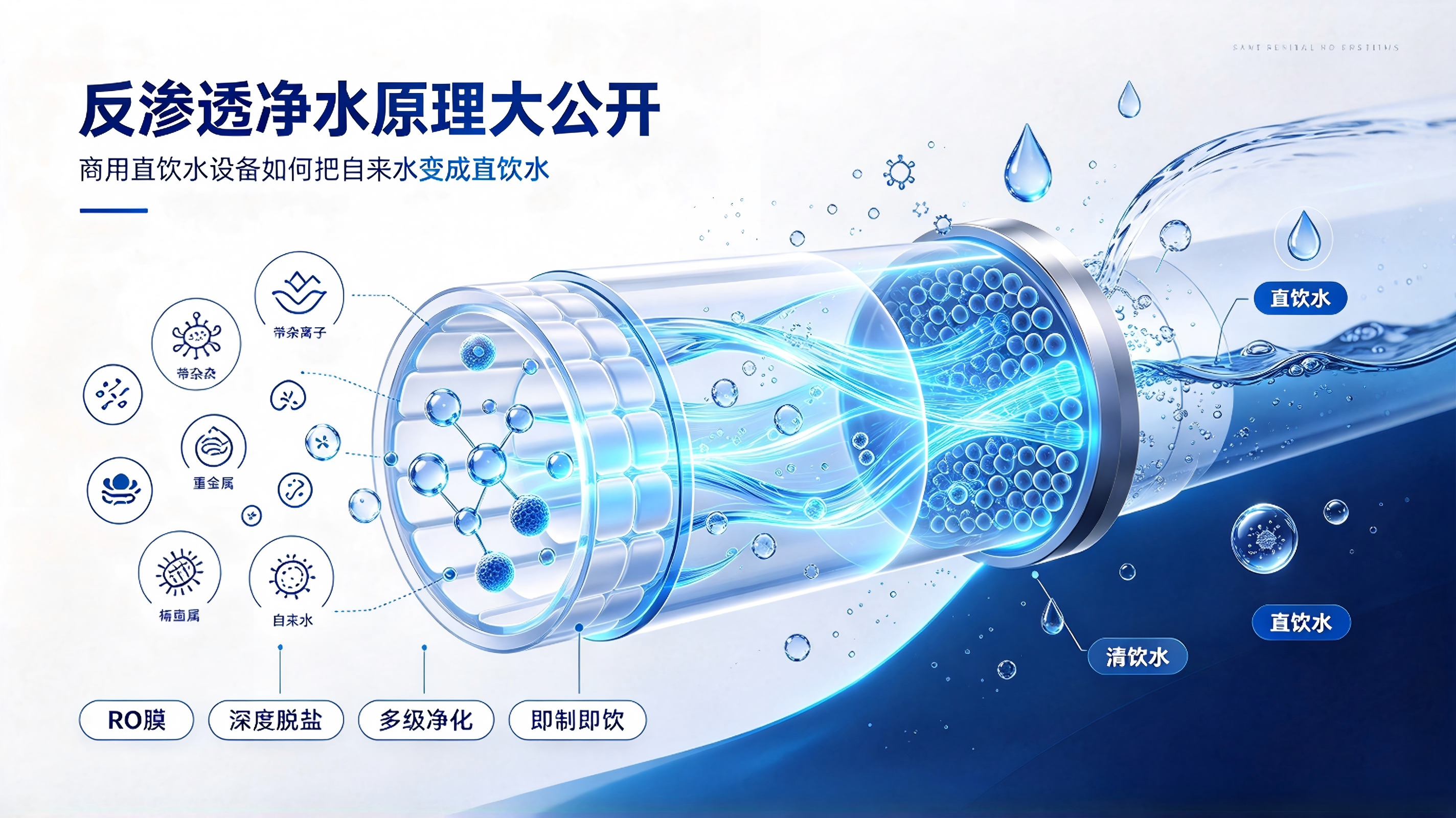
Reverse Osmosis (RO) is a water purification technology that uses pressure to drive water through a semi-permeable membrane, separating impurities. Its consumer application originated from seawater desalination: when pressure exceeds the osmotic pressure, water molecules are forced through the fine RO membrane while salts, heavy metals, and most dissolved contaminants are blocked on the other side, achieving desalination and purification.
For commercial direct drinking water systems, the RO membrane is the "heart." It removes most dissolved solids (TDS), bacteria, viruses, heavy metal ions, and some organic compounds from water, with a salt rejection rate typically ranging from 95% to 99%. This is why RO-treated water tastes purer and leaves virtually no scale when boiled.
2. How does the RO membrane "filter" out clean water?
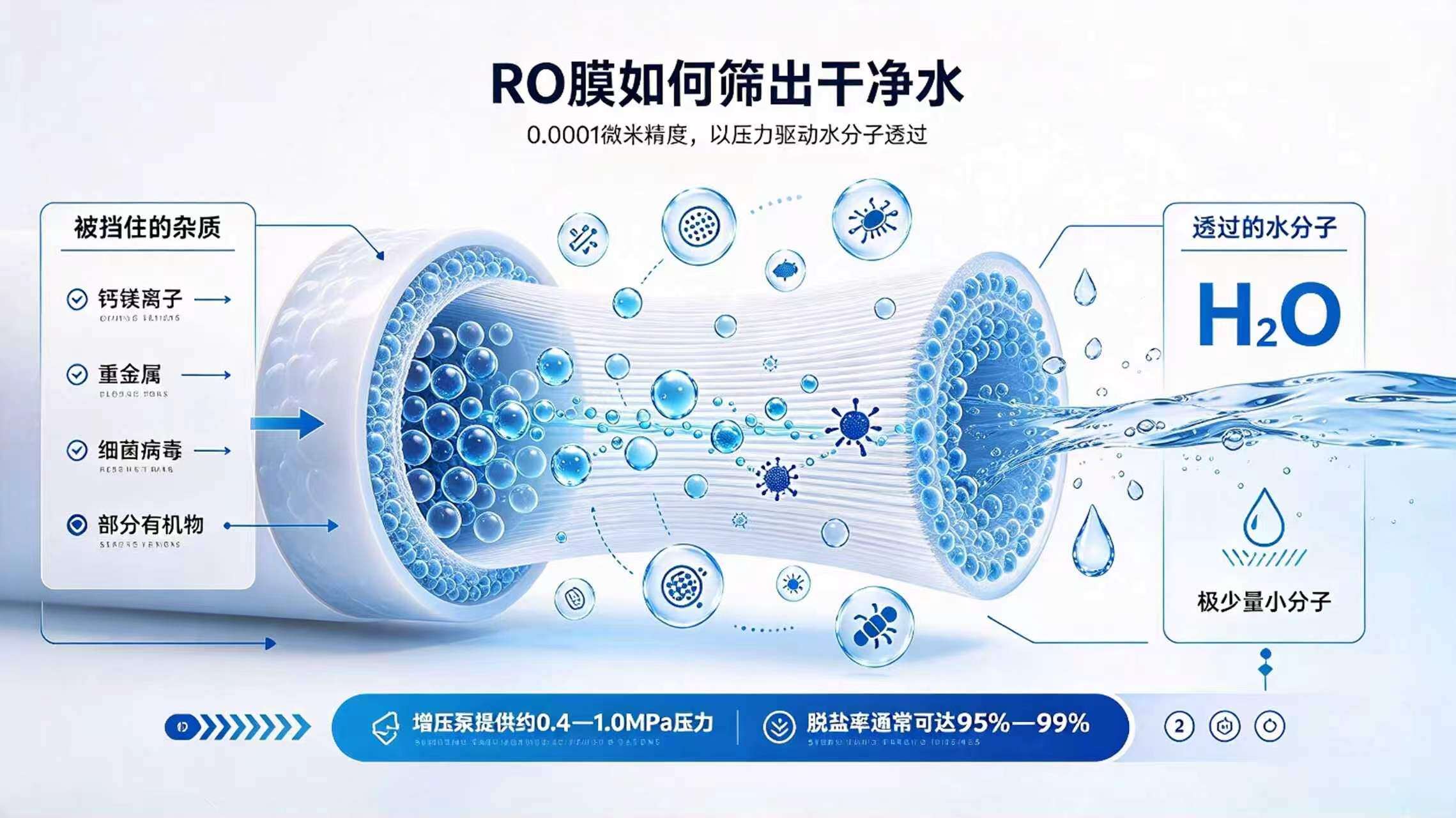
The RO membrane has a filtration accuracy of approximately 0.0001 micrometers (0.1 nanometers), roughly one-millionth the diameter of a human hair. Instead of trapping impurities with "mesh holes," it relies on the affinity between water molecules and the membrane material to allow water to pass through preferentially while repelling larger or charged ions.
The entire process can be viewed as a "microscopic screening."
Passes through the membrane: Water molecules (H₂O), along with a very small amount of smaller molecules.
Occludedcalcium and magnesium ions, sodium ions, heavy metals (lead, arsenic, cadmium, etc.), nitrates, bacteria, viruses, organic pollutants, and other harmful substances.
Sources of StressThe device's built-in pump generates approximately 0.4—1.0 MPa of pressure to drive water through the membrane.
What else is "hidden" behind RO in commercial direct drinking water equipment?
A qualified direct drinking water system is far more than just "installing one RO membrane." Take Baiyuan Water Industry's commercial direct drinking solution as an example: the typical process includes:
Preprocessing(PP Cotton + Activated Carbon): Pre-filters sediment, rust, and residual chlorine to protect the RO membrane and extend its lifespan.
RO Reverse Osmosis Core: Achieves deep desalination and sterilization, along with removal of heavy metals and organic compounds.
Post-activated carbon: Improves taste and removes odors.
Sanitation assurance(UV / Ozone, optional): Further ensures microbial safety of the output water.
Smart IoTReal-time monitoring of water quality, flow rate, and filter status with proactive maintenance alerts.
This multi-stage combination ensures water quality while simplifying operations—exactly the "stability" and "control" that commercial environments demand.
4. How Pure Is the Water? Understand These Key Indicators
To determine if drinking water is safe, don't just rely on taste; focus on objective metrics:
TDS (Total Dissolved Solids)RO output typically reaches single-digit ppm, far below tap water levels.
Microbiological IndicatorsTotal bacterial count, total coliforms, and other parameters must comply with the "National Standard for Hygiene of Drinking Water" (GB 5749-2006) or higher requirements.
Heavy Metals and NitratesEfficiently removed after RO, meeting drinking water standards.
Certified endorsementEquipped with international certifications from NSF, TÜV, SGS, and more for superior quality assurance.
All equipment provided by Baiyuan Water Industry has passed 8 major international certifications. After installation, water quality testing is conducted and a report is issued, ensuring users "feel secure using it and fully understand the results."
5. Admin/Procurement: What to Look for When Buying Commercial Direct Drinking Water Systems?
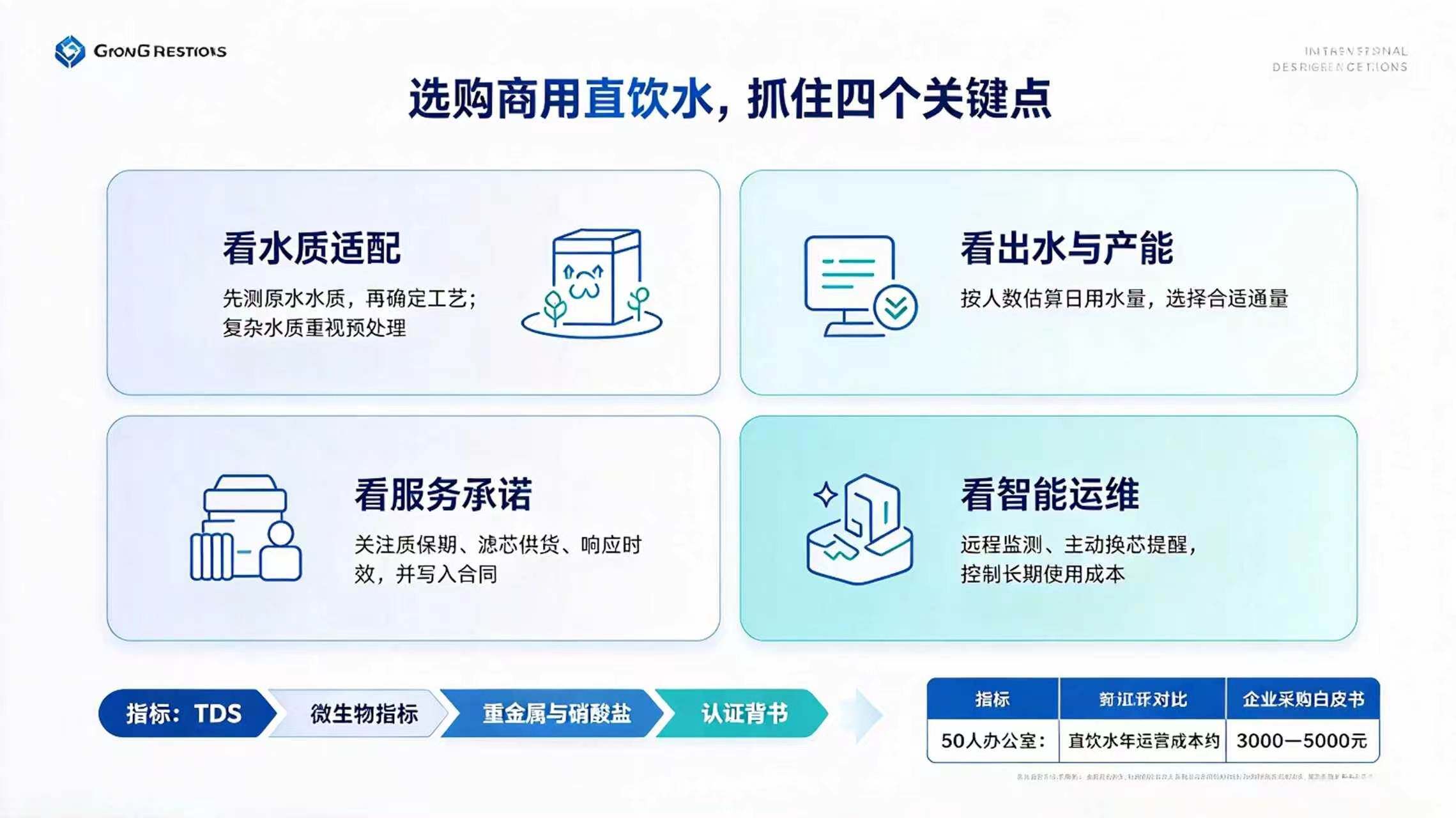
With the wide variety of devices on the market, focus on these four key points:
Check water quality compatibilityTest the raw water quality first, then determine the process. Pre-treatment is especially critical in areas with complex water quality.
Water yield and production capacityEstimate daily water usage based on household size to select the right flow rate—avoiding insufficient supply or oversized capacity.
View Service CommitmentWarranty period, filter supply, and response time — are these commitments included in the contract?
View Intelligent OperationsRemote monitoring and proactive filter replacement alerts directly impact long-term operating costs.
VI. Three Common Misconceptions About Reverse Osmosis
Misconception 1: "An RO system is enough; filter replacement isn't necessary."Pre-filters (PP cotton and activated carbon) protect the RO membrane. Failing to replace them on time can shorten the RO membrane's lifespan and compromise water quality. We recommend replacing them based on smart reminders. By sourcing directly from Baoyuan's original factory supply chain, we offer competitive pricing on genuine filters with uninterrupted availability.
Misconception 2: "All RO systems produce the same water quality."Membrane brands, pretreatment design, disinfection methods, and O&M capabilities vary significantly, directly impacting long-term stability and drinking water experience.
Misconception 3: The lower the TDS value, the better the water quality—some even pursue "0 TDS."TDS values are better suited forCheck if the RO membrane is failing(e.g., a sudden spike in TDS during water output), rather than as the sole indicator of water quality.
7. Do the Math: Tap Water vs. Bottled Water — Which Saves More?
Taking a 50-person office as an example, annual bottled water costs are approximately ¥1.5–2 (including dispenser rental, deposit, and ongoing water purchases). In contrast, commercial direct drinking water systems require only a one-time investment, with annual operating costs of just ¥3000–5000 (electricity + filter replacement). Payback typically occurs within 1–2 years, delivering long-term savings of over 60%. Additionally, on-demand dispensing eliminates the risk of secondary contamination associated with stored bottled water. This is why more and more companies are switching away from bottled water.
Conclusion: Leave water quality to the experts.
Reverse osmosis makes "on-demand drinking water" a reality and puts control over water safety back in users' hands. As a full-scenario water treatment solutions provider, Baiyuan Water Industry has strategic partnerships with top brands including 3M, GE, Pentair, A.O. Smith, Midea, Angel, Bili, and Bio-Source. Our commercial direct drinking water systems serve offices, schools, hospitals, factories, and more. We guarantee seven-star service—documented in every contract: "30-minute response, 4-hour onsite arrival, 8-hour repair completion, with a backup unit provided if deadlines are missed."
Evaluating water upgrade solutions for your office or campus? Contact Baiyuan Water Industry for a free water quality test and a customized plan.
Official Website:www.beryon.cn
Contact Us:400-101-8993
Seven-Star Service Commitment: 30 min response · 4 hr on-site · 8 hr repair · free backup device if overdue
Recommended Related Cases
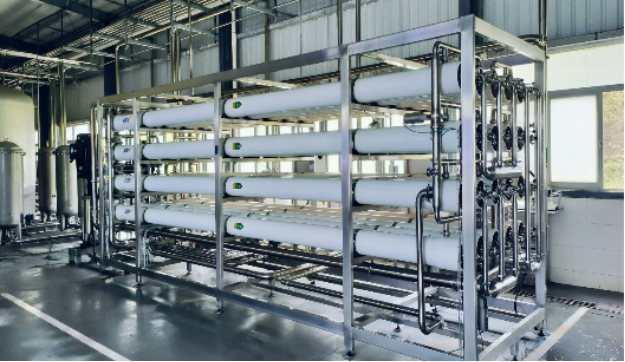
Robust Guangzhou Production Base Dual-Stage Reverse Osmosis Pure Water System Project Case | Baiyuan Water Industry
Robust Group utilizes Baiyuan Water Industry's dual-stage reverse osmosis pure water system. The produced water meets GB 19298-2014 packaging drinking water standards, with a bottled water production capacity of 2400 buckets per hour. Multi-stage pretreatment + dual-stage RO + terminal sterilization combination...
View Details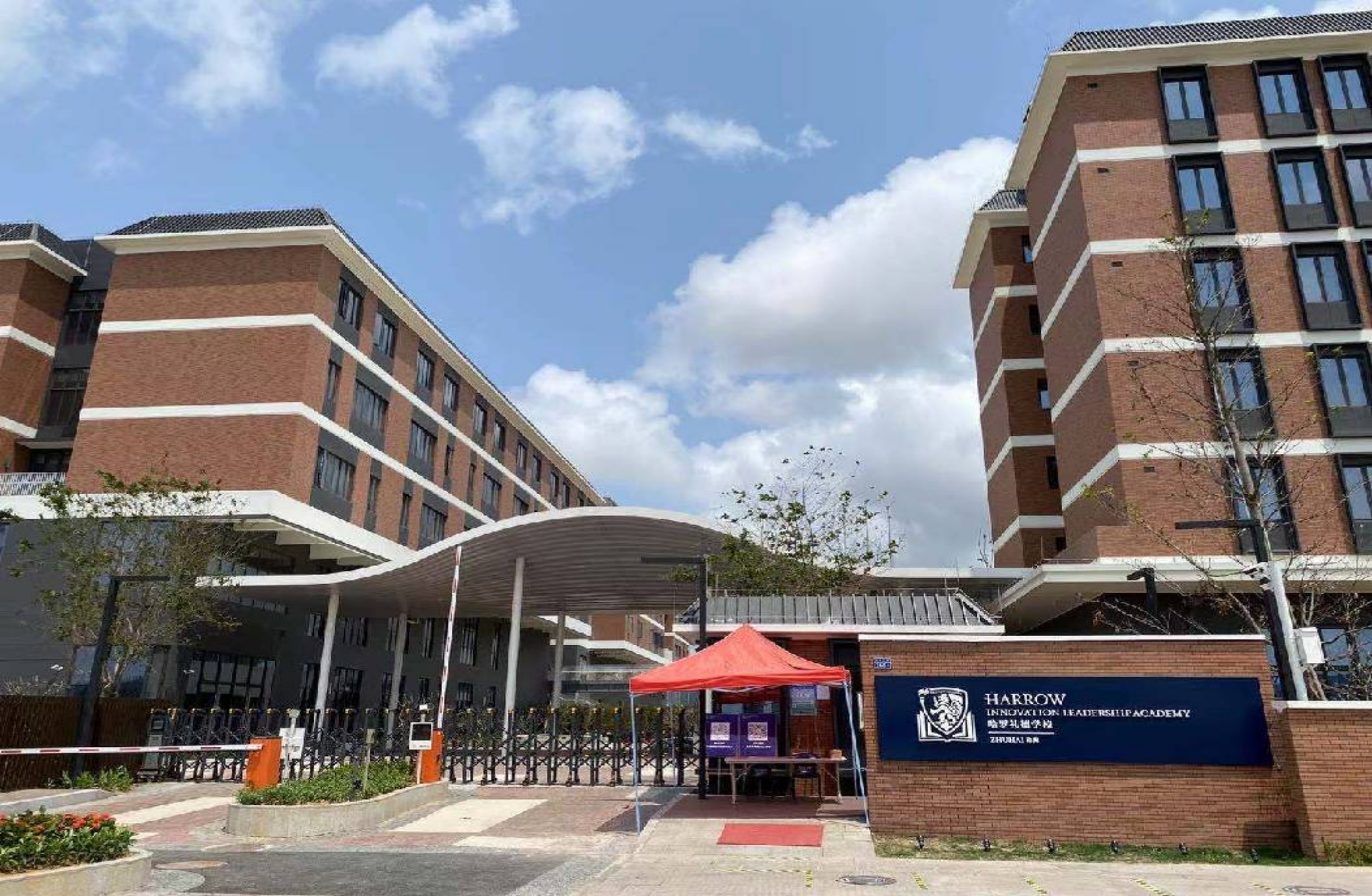
Zhuheng Hengqin Harrow Li De School Direct Drinking Water System Project Case | Baiyuan Water Industry
Baiyuan Water Industry provides a safe and healthy campus drinking water system for Zhuhai Hengqin Harrow School, covering primary, middle, and high school teaching buildings as well as dormitory areas. The system features a combination of 3M commercial drinking water purifiers and Shijifengyuan energy-saving drinking fountains, equipped with over...
View Details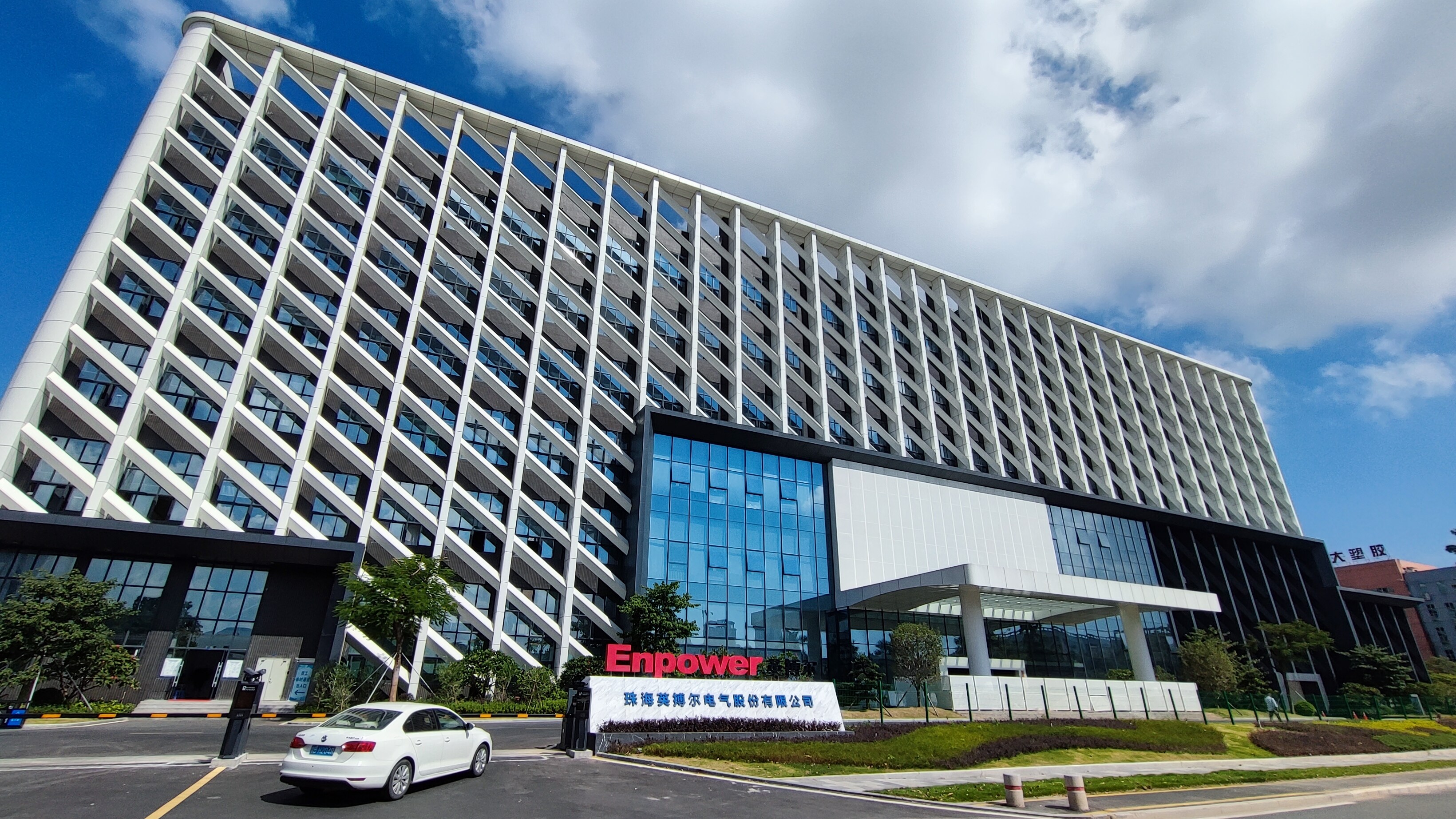
Zhuhie Inbott Electric Co., Ltd.
Secondary RO + EDI + Nuclear-Grade Resin Ultrapure Water System; produces ultrapure water for new energy equipment manufacturing (resistivity > 18.2 MΩ) and direct drinking water in the workshop.
View Details